At its September 2024 product launch at RE+ in Anaheim, Exowatt stated that its P3 modular solar-thermal system generates electricity at “an industry-leading cost of just under 4 cents per kWh.” The company has since extended that claim, targeting 1 cent per kWh at volume scale, with a co-founder specifying that 1 million units per year would be required to reach it. This piece examines the 4-cent figure as made, against the cost history of concentrating solar power, the physics of container-scale heat engines, and the manufacturing realities of a product that does not yet have a single named commercial deployment.
What the P3 is
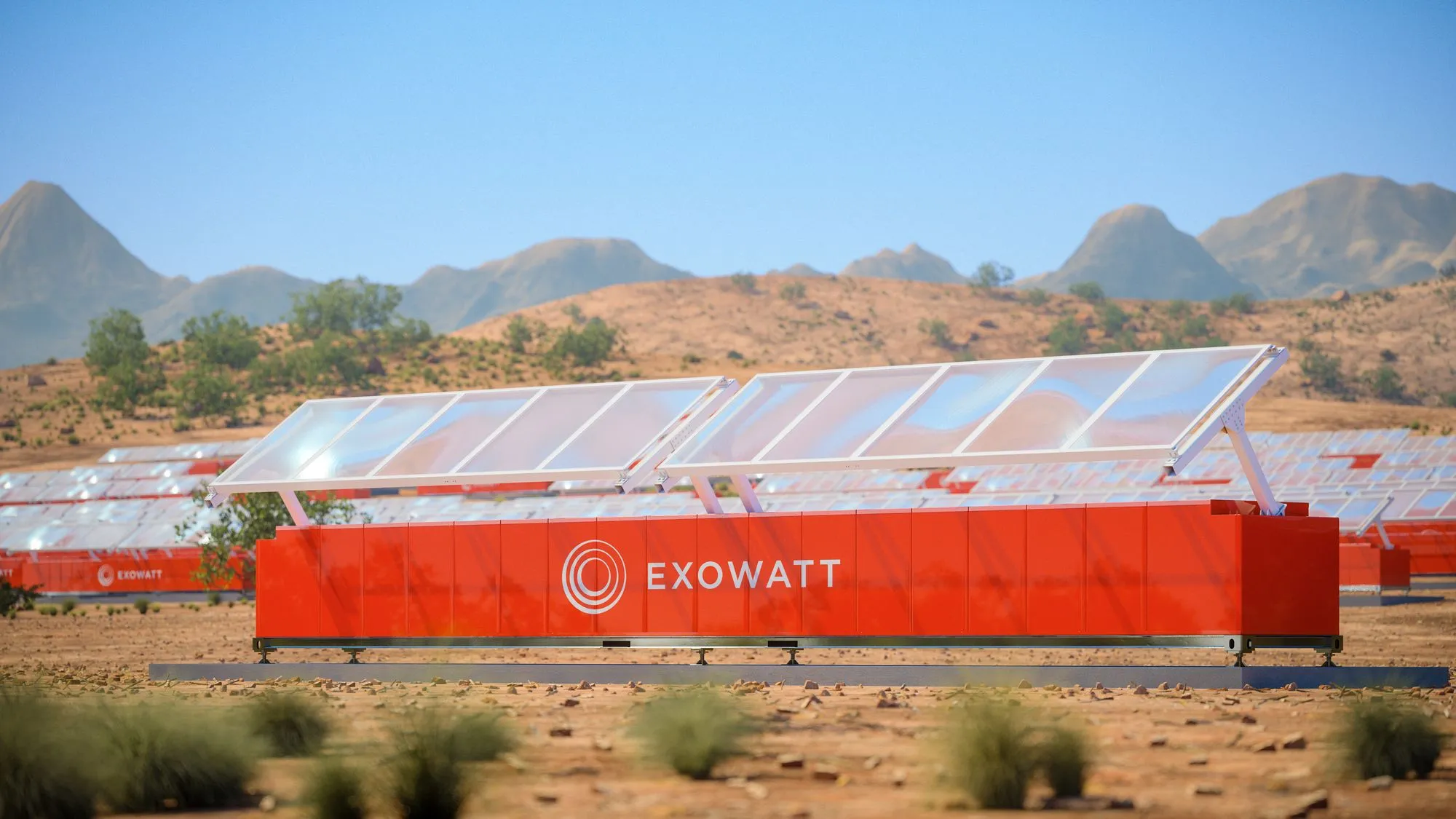
The P3 is a modular system housed in a standard 40-foot shipping container footprint. It concentrates sunlight through proprietary Fresnel lenses onto a thermal battery made of a fumed silica and silicon-based composite material, storing heat at between 500°C and 800°C. That stored heat is then dispatched through a Stirling engine to produce electricity on demand. Built-in resistive heaters allow the battery to charge directly from the grid, making the system grid-interactive rather than purely solar-dependent. The container form factor is not incidental to the cost argument: it sets a fixed upper bound on the lens aperture area available to charge the battery, a constraint that becomes important when the capacity factor assumptions behind the LCOE figure are examined.
The P3 converts solar heat to dispatchable electricity through four sequential stages, with grid charging as an optional input at stage two
Each base module, configured as two battery packs connected to one Stirling engine, produces approximately 25 kWh of electrical output and stores 150 kWh of thermal energy. The company claims a round-trip efficiency of 35 to 40 percent, which it characterizes as comparable to top-of-the-line gas generators. Deployed configurations target a 50 to 70 percent capacity factor depending on regional solar profiles, and require roughly one acre per MWh of dispatchable capacity.
The system is marketed as “install and forget,” with a 30-year design lifespan and minimal maintenance. Exowatt claims domestic U.S. materials sourcing and contract manufacturing rather than owned production facilities.
The cost claim and what is missing from it
Exowatt’s 4-cent LCOE figure has no publicly disclosed methodology. No discount rate, assumed capacity factor, geographic insolation basis, capital cost per unit, operations and maintenance inputs, or project finance structure has been published by the company or independently verified by any analyst. The figure originates from CEO statements, was echoed without supporting assumptions by lead Series A investor Felicis Ventures, and has been reported without challenge across most trade coverage.
The benchmark comparisons are instructive. IRENA’s 2024 data show utility-scale solar PV and battery storage hybrid projects in the United States achieved a weighted-average LCOE of $0.079 per kWh. A 2023 Lazard analysis cited by Latitude Media found commercial solar PV starting at 4.9 cents per kWh unsubsidized, with utility-scale as low as 2.4 cents. The global weighted-average CSP LCOE, after falling 68 percent between 2010 and 2022 to reach $0.10 per kWh for utility-scale projects, still sits well above the P3’s claimed figure. NREL’s 2024 Annual Technology Baseline puts current CSP capital expenditure at approximately $7,912 per kilowatt-electric for utility-scale trough and tower systems.
The P3’s 4-cent claim would, if accurate, represent a factor-of-2.5 improvement over the best existing utility-scale CSP cost, achieved in a containerized, small-scale format. No technical or manufacturing basis explaining how that gap is closed has been disclosed.
Exowatt separately claims thermal storage costs of “as low as $0.01 per kWh.” That figure is a storage-cost metric, not a system LCOE, and conflating the two has appeared in some press coverage. The 1-cent LCOE target, confirmed by TechCrunch in November 2025, requires scaling to 1 million units per year. At 25 kWh electrical output per unit, that implies 25 GWh of annual production capacity: a ramp with no disclosed supply chain anchor, no named factory partner, and no precedent in the thermal energy industry.
The physics problem at container scale
Two structural physics arguments have been raised by independent analysts and have not been answered by Exowatt’s public disclosures.
The first concerns charging. A CSP/thermal storage executive quoted by Latitude Media at the September 2024 launch noted that concentrating solar achieves roughly 30 percent efficiency on a sunny day, making container-scale lens arrays likely insufficient to reliably charge the battery to full capacity within a single solar day. The Fresnel lens aperture area available on a 40-foot by 8-foot container is fixed by geometry. If the thermal input rate is constrained by that aperture, the capacity factor assumptions embedded in the LCOE calculation become the number that matters most, and it has not been disclosed.
The second concerns scale. Larger thermal batteries are inherently more efficient because their volume-to-surface-area ratio reduces heat losses. A second expert quoted by Latitude Media noted this directly as a disadvantage of the small modular form factor. The P3 competes against large-scale CSP projects on cost while operating at a scale where the physics of heat retention work against it.
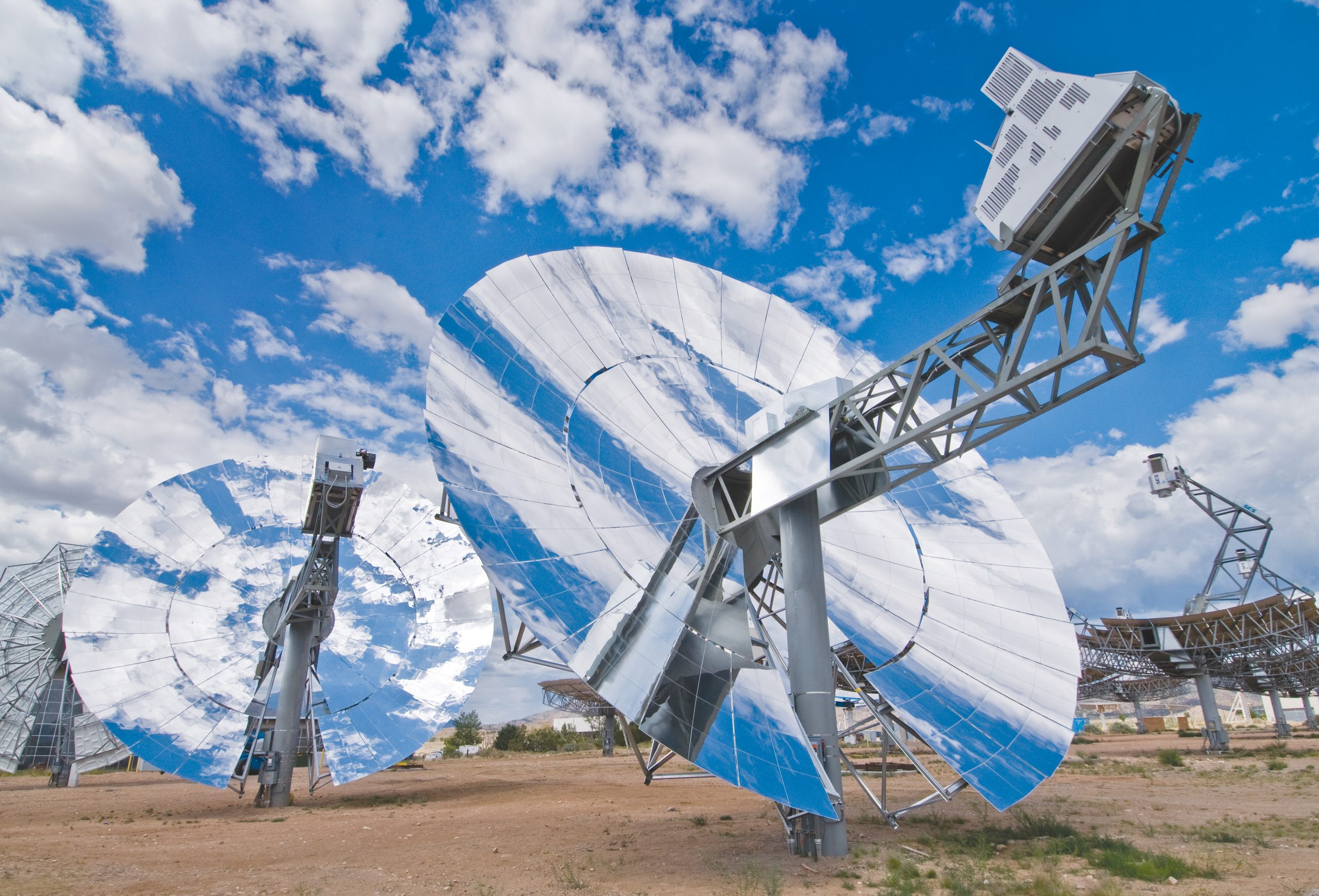
Stirling engine efficiency in deployed solar systems shows wide variation in peer-reviewed literature: 5 to 41.5 percent, depending on configuration and operating conditions. Exowatt has not publicly named its Stirling engine supplier, the engine’s rated power output per unit, or the thermal-to-electric efficiency achieved in actual deployed rather than prototype units. This is a material gap. Stirling engine cost at commercial scale was the primary failure mode for both Stirling Energy Systems, which went bankrupt in 2011, and Infinia, which went bankrupt in 2013. Exowatt’s CEO acknowledged testing multiple heat engines before selecting the Stirling, citing “reliability, performance, and supply chain” as the reasons for the choice, but the selection rationale does not address the cost structure that ended its predecessors.
Exowatt is the only player in the thermal storage segment claiming sub-$0.04/kWh LCOE and the only one without a named commercial deployment as of mid-2026
| Technology class | Scale | LCOE benchmark ($/kWh) | Named commercial deployment | Stirling/heat engine reliance | |
|---|---|---|---|---|---|
| Exowatt P3 | Fresnel lens + Stirling + sensible heat storage | Container-scale modular | Claimed <$0.04 (unverified) | None disclosed as of mid-2026 | Yes (central to design) |
| Antora Energy | Carbon-block radiative heat battery | Industrial scale | Not disclosed | 5 GWh at biofuels plant (mid-2026) | No (direct electric or steam) |
| Rondo Energy | Refractory-brick heat battery | Industrial scale | Not disclosed | Pilot-stage only | No (steam turbine) |
| Utility-scale CSP (trough/tower) | Parabolic trough or power tower | 100 MW+ projects | $0.10/kWh global avg (IRENA 2022) | Yes (multiple operational plants) | No (steam turbine) |
The manufacturing gap
Exowatt’s CEO has confirmed the company relies on U.S. contract manufacturers rather than building its own large-scale production facilities. The identity of those manufacturers, the current per-unit cost, and the learning-curve assumptions behind the volume cost target are entirely undisclosed.
The path from 4 cents per kWh today to 1 to 2 cents runs through 100 GWh of annual production. Exowatt’s own stated target is one million units a year. One million P3 units is 25 GWh at the 25 kWh electrical rating and 150 GWh at the 150 kWh thermal rating, and the company has not disclosed which of the two its GWh figures are denominated in. Consumer hardware learning curves, even aggressive ones, require named suppliers, qualified production lines, and a ramp that takes years. The Head of Supply Chain hired in February 2026, Kalyan Bhamidi, brings experience from Apple’s OLED and Vision Pro display supply chains and Caterpillar powertrain manufacturing. That profile suggests Exowatt is recruiting manufacturing-scale operators rather than CSP domain specialists, which is a coherent strategic choice but does not close the disclosure gap on where and how the units will actually be built.
The bill-of-materials cost for a Stirling engine at the quantities implied by the volume target has no public analog. Stirling engines were expensive enough at scale to bankrupt two dedicated solar companies in relatively benign market conditions. Exowatt has offered no data on how its procurement position or design changes address that historical cost structure.
Exowatt's funding reached $140 million across four events in under 24 months, with debt comprising half of the Series A
Funding, backlog, and the deployment gap
Exowatt raised $140 million in cumulative funding across four events in under two years: a $20 million seed round in April 2024 led by Andreessen Horowitz and Atomic, a $70 million Series A in April 2025 led by Felicis Ventures comprising $35 million in equity and $35 million in debt from HSBC Innovation Banking, and a $50 million Series A extension in November 2025 led by MVP Ventures and 8090 Industries. Notable angels include Sam Altman and Leonardo DiCaprio. A secondary-market data aggregator pegged an implied valuation of approximately $695 million as of November 2025, though that figure is not confirmed by the company.
Cumulative capital raised climbed steeply through 2025 but no commercial revenue has been disclosed to accompany it
The reported backlog is over 90 GWh as of November 2025, from data centers, energy developers, and hyperscalers across the United States. TechCrunch put that at approximately 10 million P3 units. At the 25 kWh electrical output Exowatt states for the P3, 90 GWh is 3.6 million units; at the 150 kWh thermal rating, 600,000. The figure of 10 million implies 9 kWh per unit, a basis matching no published Exowatt specification. The backlog grew from 500 MW cited at the April 2024 seed announcement to 1.2 GW in late 2024, then was reframed as 90 GWh by April 2025. The unit change from power to energy makes direct comparison difficult, and no specific named customers or signed contract values have been disclosed at any stage.
As of January 2026, roughly 18 months after the September 2024 product launch, Latitude Media reported that Exowatt had not disclosed any specific projects or named customers despite the 90-plus GWh backlog. The January 2026 launch of “ExoRise,” a new business arm to develop turnkey powered land for hyperscale data centers in the U.S. Southwest, was described by Latitude Media as a substantial strategic shift from the original model of selling modular P3 units. The first ExoRise pilot project is targeted to be operational by end of 2026. No completed commercial deployments have been confirmed as of the most recent available disclosures.
Team and organizational signals
CEO Hannan Happi brings relevant hardware and power engineering credentials: mechanical engineering training at the Technical University of Munich and Stanford GSB, prior roles at Siemens in combined-cycle power plant design, General Electric in wind turbines, and Tesla. His prior company, Volansi, was a hardware-heavy VTOL drone startup that went through Y Combinator in 2017 before acquisition by a defense contractor. That track record is the closest analog to Exowatt’s operational model, though drone logistics operates at substantially lower capital intensity than multi-GWh solar-thermal manufacturing.
The February 2026 executive hiring wave added a Chief Data Center Officer with 25 years of hyperscale experience, a Head of Engineering from aerospace and defense, a Head of Supply Chain from consumer hardware, and a General Counsel from AWS. The technical co-founder with the relevant mechanical engineering PhD, Sushrut Bapat, who had prior experience at SunPower, has departed Exowatt and moved to a stealth-mode startup, transitioning to an advisory role. That departure, confirmed by LinkedIn but not by company press release, removes the deepest domain technical credential from the active team at a stage when thermal design is still the core engineering challenge.
Exowatt appointed its first CFO, Suchet Singh, in June 2026, a signal the company is formalizing its finance function ahead of what would need to be significantly larger capital deployment if manufacturing is to begin in earnest.
The binding constraint
That cost history is the reason the missing disclosure matters. The binding constraint on the 4-cent LCOE claim is the absence of a disclosed Stirling engine unit cost at any production volume. Everything else in the LCOE calculation, including insolation assumptions, capacity factor, and O&M, is sensitive to geography and design choices and could plausibly be optimized. The Stirling engine cannot be. Its per-unit cost at the volumes required to reach the claimed LCOE has no publicly established floor.
This constraint binds for a specific reason: two companies that built their businesses on the same technology class, Stirling Energy Systems and Infinia, both failed in the early 2010s with the Stirling engine cost at commercial scale cited as the primary failure mode. Exowatt has not disclosed what has changed in the cost structure of the engine, who supplies it, at what price, or what design modifications address the durability issues that ended its predecessors. Until a supplier is named and a production-volume price is disclosed, no independent analyst can construct an LCOE from first principles that would support or refute the 4-cent figure.
What would have to change for this constraint to stop binding: Exowatt would need to disclose its Stirling engine supplier and the contracted unit price at a production volume of at least tens of thousands of units, alongside a bill-of-materials cost structure that shows the engine’s share of total system cost. Alternatively, a third-party performance and cost audit of a deployed P3 system at commercial scale would provide the data from which an independent LCOE could be derived.
What would change this assessment
More confidence that the claim holds would come from: a completed ExoRise pilot project with independently verified performance data by end of 2026; a Stirling engine supply agreement with a named manufacturer that has demonstrated production at scale in an adjacent industry; or NREL or LBNL inclusion of the P3 in a technology assessment with disclosed assumptions.
Less confidence would come from: further delay in the first ExoRise pilot beyond 2026, particularly if accompanied by another strategic pivot; disclosure that the Stirling engine is being sourced from a single small supplier without volume production history; or departure of additional senior technical staff from the thermal design function.
The market backdrop does not resolve the physics. U.S. data center power demand is projected by Goldman Sachs to grow from 31 GW in 2025 to 66 GW by 2027, and grid interconnection queues stretching four to seven years are a genuine structural driver for behind-the-meter solutions. Those conditions create real demand for what Exowatt is selling. They do not validate the price at which it claims to sell it.
Observables
The first tell is permitting and environmental review filings for the first ExoRise pilot project, expected operational by end of 2026, in New Mexico, West Texas, Arizona, or Nevada. Construction permits and NEPA or state-level environmental review documents are public records searchable through county planning databases and state environmental agency portals. If permitting has not been initiated by Q3 2026, the end-of-2026 operational target is not achievable.
The second tell is import and customs records for Stirling engine components or assemblies. If Exowatt is sourcing engines from an overseas manufacturer at volume, U.S. Customs and Border Protection import data, accessible through services such as ImportYeti or Panjiva, would show shipment records by Q4 2026 for any meaningful production run.
The third tell is NREL or LBNL inclusion of the P3 in a published technology cost assessment, which would require Exowatt to disclose performance and cost data to a credible independent reviewer. NREL’s Annual Technology Baseline updates annually and explicitly tracks emerging modular solar-thermal technologies. Absence from the 2026 ATB would be informative.
The fourth tell is a power purchase agreement or commercial energy services contract filed with a state public utilities commission or disclosed in a counterparty’s SEC filing. A hyperscaler or data center developer that signs a multi-year PPA for P3-supplied power at a disclosed price per kWh would provide the most direct independent validation of the LCOE claim, by a party with legal and financial exposure to the accuracy of the price.
New research by email. Roughly one piece a month.
Sources (53)
- EXOWATT
Exowatt Secures $20M to Power the AI Era with Next-Gen Renewable Energyexowatt.com
- DATACENTERDYNAMICS
OpenAI's Sam Altman and a16z back data center-focused thermal energy company Exowatt - DCDdatacenterdynamics.com
- EXOWATT
Exowatt Closes $70 Million in Series A Funding to Deploy and Scale the Exowatt P3exowatt.com
- GLOBENEWSWIRE
Exowatt Closes $70 Million in Series A Funding to Deploy and Scale the Exowatt P3 - GlobeNewswireglobenewswire.com
- EXOWATT
Exowatt Raises Additional $50 Million to Accelerate US Dispatchable Solarexowatt.com
- ESGTODAY
- TECHCRUNCH
Sam Altman-backed Exowatt wants to power AI data centers with billions of hot rocks - TechCrunchtechcrunch.com
- PREMIERALTS
Exowatt Valuation 2026: $695.0M - Premier Alternativespremieralts.com
- EXOWATT
- ESS-NEWS
Thermal storage startup Exowatt gets funding injection from Silicon Valley VCs - Energy Storage Newsess-news.com
- LATITUDEMEDIA
The trouble with Exowatt's 'groundbreaking' tech - Latitude Medialatitudemedia.com
- EXOWATT
Exowatt Unveils Pioneering Modular Energy Platform - Exowatt / BusinessWireexowatt.com
- EXOWATT
Exowatt FAQ - Get Answers About Our Energy Technologyexowatt.com
- FACILITIESDIVE
Exowatt's 'next-generation renewable energy' tech could power data centers faster - Facilities Divefacilitiesdive.com
- PV-MAGAZINE-USA
Sam Altman-backed Exowatt targets 'Frontier Land' data centers with modular solar thermal storage - PV Magazine USApv-magazine-usa.com
- SUBSTACK
Exowatt: A New Take on Solar Data Centers - Data Center Richness (Substack)datacenterrichness.substack.com
- PV-TECH
IRENA: Global solar PV LCOE increases by 0.6% in 2024 to US$0.043/kWh - PV Techpv-tech.org
- SCIENCEDIRECT
The economics of concentrating solar power (CSP): Assessing cost competitiveness - ScienceDirectsciencedirect.com
- NREL
Concentrating Solar Power - 2024 ATB - NRELatb.nrel.gov
- RENEWABLEMARKETWATCH
IRENA Renewable Power Generation Costs 2024 - Renewable Market Watchrenewablemarketwatch.com
- ARXIV
Convective meta-thermal concentration for ultrahigh efficient Stirling engine - arXivarxiv.org
- FELICIS
- WIKIPEDIA
Exowatt - Wikipediaen.wikipedia.org
- EXOWATT
Exowatt Scales Executive Team to Meet AI's Surging Energy Demand with Dispatchable Solarexowatt.com
- BUSINESSWIRE
Exowatt Scales Executive Team to Meet AI's Surging Energy Demand with Dispatchable Solar - Business Wirebusinesswire.com
- PULSE2
Exowatt: Interview With CEO Hannan Happi About The Renewable Energy Company - Pulse 2.0pulse2.com
- MCJ
MCJ's Investment in Exowatt - MCJ Newsletternewsletter.mcj.vc
- LINKEDIN
Sushrut Bapat, PhD - LinkedInlinkedin.com
- EXOWATT
Scaling Up: Exowatt's Rapid Growth and New Headquartersexowatt.com
- REFRESHMIAMI
Exowatt wants to solve AI's biggest problem: power, and lots of it - Refresh Miamirefreshmiami.com
- GOLDMANSACHS
US Data Center Power Demand Projected to Double by 2027 - Goldman Sachsgoldmansachs.com
- MORGANSTANLEY
Energy Markets Race to Solve the AI Power Bottleneck - Morgan Stanleymorganstanley.com
- AOSHEARMAN
Data centers and the rise of behind-the-meter power - A&O Shearmanaoshearman.com
- EXOWATT
Exowatt Launches 'ExoRise' to Deliver Turnkey Powered Land and Energy for the AI Eraexowatt.com
- LATITUDEMEDIA
Exowatt is embracing a new business model - Latitude Medialatitudemedia.com
- DATACENTERDYNAMICS
Exowatt raises $70m in Series A funding, touts 90GWh pipeline from data center market - DCDdatacenterdynamics.com
- GMINSIGHTS
Concentrated Solar Power Market Size, 2025-2034 Trends Report - GMInsightsgminsights.com
- PITCHBOOK
Exowatt 2026 Company Profile: Valuation, Funding & Investors - PitchBookpitchbook.com
- CANARYMEDIA
Antora snags $550M for heat batteries to run data centers - Canary Mediacanarymedia.com
- SEC
- LATITUDEMEDIA
Do heat batteries make sense for data centers? - Latitude Medialatitudemedia.com
- THERMALBATTERYALLIANCE
Thermal Battery Alliance Announcementthermalbatteryalliance.com
- EXOWATT
Exowatt P3: Breakthrough in Dispatchable Solar - Exowattexowatt.com
- BUSINESSWIRE
Exowatt Wins Fast Company's 2025 Next Big Thing in Tech Award - Business Wirebusinesswire.com
- UTILITYDIVE
Exowatt's 'next-generation renewable energy' tech could power data centers faster - Utility Diveutilitydive.com
- CBINSIGHTS
Exowatt Financials - CB Insightscbinsights.com
- ESGDIVE
Sam Altman-backed Exowatt launches arm to power data centers with clean energy - ESG Diveesgdive.com
- EXOWATT
Exowatt P3 - Modular 24/7 Energy for the AI Era - Exowatt.comexowatt.com
- CBINSIGHTS
Exowatt CEO, Founder, Key Executive Team, Board of Directors & Employees - CB Insightscbinsights.com
- NASA
NASA Glenn Research Center, "Dynamic Thermal Energy Conversion"nasa.gov
- NASA
- NASA
- PRNEWSWIRE
PR Newswire, "Stirling-engine Developer Qnergy Acquires US-based Infinia," November 2013prnewswire.com