Executive Summary
In June 2026, BMW Group published a statement claiming that its 11-month deployment of Figure 02 at Plant Spartanburg “proved that humanoids are no longer lab experiments — they can be a valuable asset in establishing a flexible, reliable manufacturing workforce.” The claim is worth examining carefully, because Figure AI has since been valued at $39 billion, is shipping robots at one per hour from its California factory, and is preparing to enter European markets governed by a mandatory new machinery regulation taking effect in January 2027. The question this article addresses is whether a dynamically-stable humanoid working alongside people can be built to a defensible safety case under ISO 10218:2025, OSHA lockout-tagout requirements, and the EU Machinery Regulation 2023/1230. The answer, based on available evidence, is undetermined, and the uncertainty is concentrated in a single structural gap that no amount of production throughput resolves.
Figure AI's valuation rose 78-fold in 28 months, reaching $39 billion on near-zero disclosed revenue
The Claim, Examined
The BMW statement is specific in what it asserts and careful in what it does not. “Valuable asset” and “flexible, reliable” are operational claims about task performance in a live factory environment. The statistics behind them are impressive on their face: over 90,000 parts loaded, 1,250 total runtime hours, and a contribution to production of more than 30,000 BMW X3 vehicles, with placement accuracy above 99% per shift and a cycle time of 84 seconds.
However, a Fortune investigation published in April 2025 reported that for much of the deployment only a single robot was performing one limited task, raising questions about how the broader characterization was supported. The BMW press release confirms the deployment involved two Figure 02 robots. Whether two robots running a single pick-and-place task for 11 months constitutes proof that humanoids can serve as a “flexible, reliable manufacturing workforce” depends heavily on how one defines “workforce.” The wording holds. The claim is doing more narrative work than the deployment data alone can sustain.
What the BMW deployment does not address, and what the claim does not mention, is the regulatory architecture that must be in place before that workforce can scale. That is where the analysis turns.
Three regulatory frameworks apply to Figure 03, and none fits a dynamically-stable humanoid without a bespoke bridge
The Regulatory Terrain: Three Frameworks, Three Problems
ISO 10218:2025 and the Legged-Robot Gap
The revised ISO 10218:2025 industrial robot safety standard is the natural starting point for any manufacturer building a humanoid for factory use. There is, however, a problem with the standard itself: ISO 10218:2025 was written for statically stable industrial robots and explicitly excludes the mobility aspects of dynamically-stable legged and bipedal systems like Figure 03. The dedicated standard for legged humanoid robots, ISO/CD 25785-1, remains at committee-draft stage as of mid-2026 and has not been published; its scope covers robots that “could become unstable in the absence of power”.
The practical consequence is that any safety case built under ISO 10218:2025 alone is structurally incomplete for a dynamically-stable humanoid. Engineers must currently bridge this gap by overlaying ISO 12100 risk assessment methodology with an AI risk management framework, a bespoke approach that has not been validated by a published international standard and that different notified bodies may interpret differently.
OSHA Lockout/Tagout: The Balance Problem
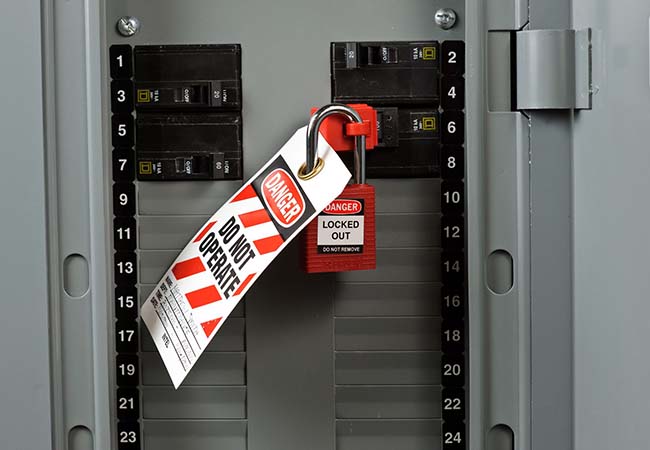
OSHA’s lockout/tagout standard (29 CFR 1910.147) requires that equipment be de-energized before servicing. For a bipedal robot, this creates a hazard that the standard was not designed to contemplate: cutting power removes the active balance control that keeps the robot upright, meaning de-energization itself creates a new struck-by hazard from a falling robot. Standard LOTO procedures are therefore inapplicable in their traditional form.
The compliant alternative is OSHA’s alternative energy control procedure pathway, which requires a documented six-step controlled shutdown, mechanical bracing before battery isolation, specialized written procedures, and training not typical in standard factory safety programs. LOTO ranked fourth on OSHA’s FY2025 most-cited standards list, with 2026 penalties reaching up to $165,514 per willful violation. There is no public evidence that Figure AI has published or implemented a robot-specific LOTO procedure of this type for the BMW Spartanburg deployment or any other facility.
EU Machinery Regulation 2023/1230: The January 2027 Cliff
The pressure sharpens considerably for European expansion. The EU Machinery Regulation 2023/1230 becomes mandatory on January 20, 2027, replacing the Machinery Directive across all 27 member states with no national transposition variation and no grace period for new machine placements. For an AI-driven humanoid, it introduces five new Essential Health and Safety Requirements absent from the old Directive: protection of safety-critical software against cybersecurity attack; safety review of self-learning AI behavior (meaning a post-deployment Helix model update that changes robot behavior requires a new safety assessment); a mandatory human supervisory function; digital documentation with 10-year retention; and a provision that substantially modifying a machine, physically or via software update, can make the modifier the manufacturer with full CE marking obligations.
There is no public evidence that Figure AI has begun EU Machinery Regulation conformity assessment or CE marking preparation for Figure 03. BMW is reportedly evaluating expansion to European plants in Munich, Dingolfing, and Regensburg. If that expansion proceeds before a conformity assessment is complete, the legal exposure lands on the deployer as much as the manufacturer.
The Binding Constraint
The Whistleblower Signal
The constraint is not merely theoretical. In November 2025, former Head of Product Safety Robert Gruendel filed a federal whistleblower lawsuit alleging wrongful termination after warning CEO Brett Adcock and chief engineer Kyle Edelberg that Figure 02 robots were powerful enough to fracture a human skull, citing internal impact testing showing forces more than double those required to break an adult skull. The complaint also alleged that Figure AI had “no formal safety procedures, incident-reporting systems, or risk-assessment processes” at the time of his hire, and that executives “gutted” a product safety roadmap prepared for two prospective Series C investors. A separate incident is described in which a robot malfunctioned and carved a deep gash into a stainless-steel refrigerator door.
Figure AI disputed the claims, stating Gruendel was terminated for poor performance. The lawsuit is unresolved, and its allegations are unproven. What the lawsuit establishes as a matter of public record, regardless of its outcome, is that the company’s most senior safety officer was terminated in September 2025, approximately five weeks before Figure 03 launched and two weeks before the Series C closed at $39 billion. There is no public evidence of who now holds the product safety function or whether the safety governance structure has been rebuilt.
Figure AI's safety governance structure changed materially in September 2025, and the current state has not been publicly disclosed
Safety Governance at Figure AI — Pre-September 2025
- Robert Gruendel serving as Head of Product Safety (20+ year veteran)
- Product safety roadmap prepared for Series C investors
- Internal impact testing conducted on Figure 02
- Incident-reporting system and risk-assessment process reportedly absent at hire (per Gruendel complaint)
Safety Governance at Figure AI — Post-September 2025
- Gruendel terminated September 2, 2025
- No public disclosure of replacement Head of Product Safety
- No public safety certification (TÜV, UL, or equivalent) for Figure 03
- No public conformity assessment under EU Machinery Regulation
- 80+ functional verification tests and 50+ inspection checkpoints per unit at BotQ (manufacturing quality system)
Technology and Production: What Is Working
Setting aside the regulatory gap, the engineering trajectory is real. Figure 03, launched October 9, 2025, stands 168 cm tall, weighs approximately 60 to 61 kg, carries 20 kg payloads, and operates on a 2.3 kWh battery for four to five hours. Its 40 degrees of freedom, palm-embedded cameras, and tactile fingertip sensors capable of detecting forces as small as 3 grams represent a meaningful hardware step from its predecessor.
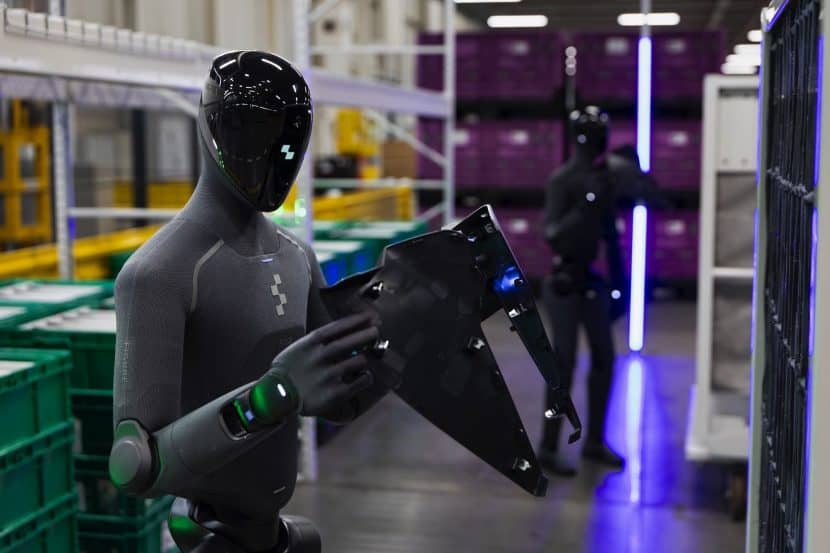
The AI architecture has evolved in parallel. Helix, Figure’s proprietary vision-language-action model, was publicly introduced in February 2025 after the company ended its OpenAI model partnership. Helix 02, released in January 2026, added a third processing layer executing at 1 kHz to handle balance, contact forces, and whole-body coordination, trained on over 1,000 hours of human motion data and replacing hand-engineered locomotion controllers.
Manufacturing has scaled faster than most observers expected. BotQ, Figure’s San Jose facility, reached one Figure 03 per hour by late April 2026, up from one per day in January, a 24-fold throughput improvement in under 120 days. Over 350 units had been delivered by that point, with end-of-line first-pass yield above 80% and battery line yield at 99.3% across 500-plus packs. Each robot passes 50-plus in-process inspection checkpoints and 80-plus functional verification tests before shipping. That quality system is an early building block for a safety case, but it is a manufacturing quality system, not a conformity assessment against a safety standard.
From Series A onward each round was larger than the last, and the Series C at $1B+ exceeded all prior rounds combined
Financial Position and the Valuation Question
Figure AI has raised approximately $1.9 billion, including $675 million in its Series B in February 2024 and more than $1 billion in a Series C that closed September 16, 2025 at a $39 billion post-money valuation, with PitchBook putting the total at $2.34 billion and Tracxn at $1.75 billion on differing treatments of founder seed capital and secondary activity. Whatever is constraining this company, it is not capital.
Cumulative capital raised crossed $1.8 billion after the Series C, with most of it raised since early 2024
Competitive Context
Agility’s Digit has the strongest commercial deployment record, with 65,000-plus operating hours across nine facilities. Chinese manufacturers, principally AgiBot and Unitree, accounted for roughly 90% of the estimated 16,000 to 18,000 global humanoid units shipped in 2025, with Unitree pricing starting at $4,900. The cost differential is not a narrow one, and it is the vector most likely to pressure Figure’s industrial pricing over time.
The auto-industry partnership pattern is instructive. Every major automaker except Tesla is partnering with a specialist humanoid robotics firm: BMW with Figure AI, Hyundai with Boston Dynamics, Mercedes-Benz with Apptronik, Toyota with Agility Robotics. That structure concentrates both the commercial opportunity and the reputational risk. A safety incident at BMW Spartanburg would land on both companies simultaneously.
What Would Change This
New research by email. Roughly one piece a month.
Sources (51)
- BMWGROUP
BMW Group advances use of Physical AI with Figure 03 at Spartanburgpress.bmwgroup.com
- FIGURE
Figure Exceeds $1B in Series C Funding at $39B Post-Money Valuation — Figure AI Officialfigure.ai
- PRNEWSWIRE
Figure Exceeds $1B in Series C Funding at $39B Post-Money Valuation — PR Newswireprnewswire.com
- INTELCAPITAL
Figure Exceeds $1B in Series C Funding at $39B Post-Money Valuation — Intel Capitalintelcapital.com
- PRNEWSWIRE
Figure Raises $675M at $2.6B Valuation and Signs Collaboration Agreement with OpenAI — PR Newswireprnewswire.com
- SACRA
- WIKIPEDIA
Figure AI — Wikipediaen.wikipedia.org
- FORGEGLOBAL
Forge Global secondary-market price page — Figure AIforgeglobal.com
- FIGURE
Introducing Figure 03 — Figure AIfigure.ai
- FIGURE
Helix: A Vision-Language-Action Model for Generalist Humanoid Control — Figure AIfigure.ai
- FIGURE
Introducing Helix 02: Full-Body Autonomy — Figure AIfigure.ai
- FIGURE
Scaling Helix: a New State of the Art in Humanoid Logistics — Figure AIfigure.ai
- THEROBOTREPORT
Figure humanoid robots use Helix VLA model to demonstrate household chores — The Robot Reporttherobotreport.com
- INTERESTINGENGINEERING
Figure robot gets AI brain that enables human-like full-body control — Interesting Engineeringinterestingengineering.com
- FIGURE
BotQ: A High-Volume Manufacturing Facility for Humanoid Robots — Figure AIfigure.ai
- FIGURE
- THEROBOTREPORT
Figure AI unveils BotQ high-volume humanoid manufacturing facility — The Robot Reporttherobotreport.com
- ROBOTICSANDAUTOMATIONNEWS
Figure ramps up humanoid robot manufacturing at unprecedented speed — Robotics & Automation Newsroboticsandautomationnews.com
- FIGURE
F.03 Arrives at BMW — Figure AIfigure.ai
- REPAIRERDRIVENNEWS
Humanoid robots complete 11-month project at BMW plant — Repairer Driven Newsrepairerdrivennews.com
- IIOT-WORLD
Physical AI Deployment ROI: BMW's 30,000-Car Proof — IIoT Worldiiot-world.com
- THEROBOTREPORT
BMW Group deploys Figure 03 humanoid after tests with previous version — The Robot Reporttherobotreport.com
- ISO
ISO 10218-1:2025, Robotics — Safety requirements — Part 1 (ISO catalogue entry)iso.org
- ISO
ISO/CD 25785-1, draft under committee review (ISO catalogue entry)iso.org
- THEROBOTREPORT
ISO 10218 industrial robot safety standard receives major overhaul — The Robot Reporttherobotreport.com
- OSHA
29 CFR 1910.147, The control of hazardous energy (lockout/tagout) — OSHAosha.gov
- EUROPA
Regulation (EU) 2023/1230 on machinery — EUR-Lexeur-lex.europa.eu
- EFS
EU Machinery Regulation 2023/1230 — Requirements, obligations and implementation — EFS Consultingefs.consulting
- CNBC
- COURTLISTENER
Gruendel v. Figure AI, Inc., No. 5:25-cv-10094 (N.D. Cal., filed November 21, 2025) — CourtListener docketcourtlistener.com
- INTERESTINGENGINEERING
Figure robot hand could 'fracture a human skull,' whistleblower warns — Interesting Engineeringinterestingengineering.com
- ROBOTICSANDAUTOMATIONNEWS
Former Figure AI engineer claims company's humanoid robots 'powerful enough to fracture human skull' — Robotics & Automation Newsroboticsandautomationnews.com
- DDG
Grendel v. Figure AI: whistleblower vs. robot safety risks — DDGddg.fr
- WIKIPEDIA
Brett Adcock — Wikipediaen.wikipedia.org
- FIGURE
Master Plan — Figure AIfigure.ai
- IEEE
Humanoid Robots: Robotics Experts Found Persona AI Startup — IEEE Spectrumspectrum.ieee.org
- TECHCRUNCH
Persona's founders are certain the world can use another humanoid robot — TechCrunchtechcrunch.com
- CONTRARY
Report: Figure Business Breakdown & Founding Story — Contrary Researchresearch.contrary.com
- SOURCERY
- DLAPIPER
DLA Piper advises Parkway Venture in its participation in US$675 million Series B investment in Figure AIdlapiper.com
- MARKETSANDMARKETS
Humanoid Robot Market Size, Share, Latest Trends & Growth Analysis, 2026–2035 — MarketsandMarketsmarketsandmarkets.com
- GRANDVIEWRESEARCH
Humanoid Robot Market Size, Share & Growth Report, 2033 — Grand View Researchgrandviewresearch.com
- FORTUNE
Is Figure AI's BMW robot partnership what its founder Brett Adcock says? — Fortunefortune.com
- TRACXN
Figure — 2026 Company Profile, Team, Funding & Competitors — Tracxntracxn.com
- ROBOTICSANDAUTOMATIONNEWS
Inside Figure AI: How this startup is reshaping the future of humanoid robots — Robotics & Automation Newsroboticsandautomationnews.com
- ROBOTICS247
General-purpose humanoid developer Figure AI exceeds $1 billion after Series C — Robotics 24/7robotics247.com
- TECHCRUNCH
Figure reaches $39B valuation in latest funding round — TechCrunchtechcrunch.com
- INTERESTINGENGINEERING
US: BMW deploys Figure 03 humanoid at smart factory for logistics — Interesting Engineeringinterestingengineering.com
- REVELIOLABS
Figure AI Number of Employees 2026 — Revelio Labsreveliolabs.com
- COUNTERPOINTRESEARCH
Figure AI Unveils its 2nd-Gen Robot — Counterpoint Researchcounterpointresearch.com
- FORBES
Humanoid Robots in Manufacturing: Timelines, Cost, And Opportunity — Forbesforbes.com