Executive Summary
On March 19, 2026, Terabase Energy announced that its next-generation Terafab V2 automated solar construction platform had completed field testing and was ready for commercial shipment. Embedded in that announcement was a manufacturing claim that deserves careful reading: “Over the next 12 months, Terabase is building factory capacity at its Northern California facility capable of installing up to 10 GW per year.”
That claim rests on a chain of arithmetic, and the same release states it: “A single line achieves 2-minute cycle times that, running 24/7 around the clock, translate to more than 20 megawatts installed per week, or roughly 1 gigawatt per factory per year.” Ten such lines, therefore, yield 10 GW annually. The logic is internally consistent. The question is what happens between the whiteboard and the field.
Three assumptions under the claim, as the company states them and as the author reads them
The public record supplies a starting position: V1 Terafab was deployed across five commercial projects in the United States, accumulating a cumulative 40 MW of installed capacity by March 2025 and, by the company’s own product page, 100 or more MW by late 2025 or early 2026. As of April 2026, only two deployable V2 units existed. A third was targeted by end of 2026 and ten by Q2 2027. The path from two to ten lines, and from ten lines to sustained 10 GW annual installation, is where the claim earns or loses credibility.
The Claim and What Surrounds It
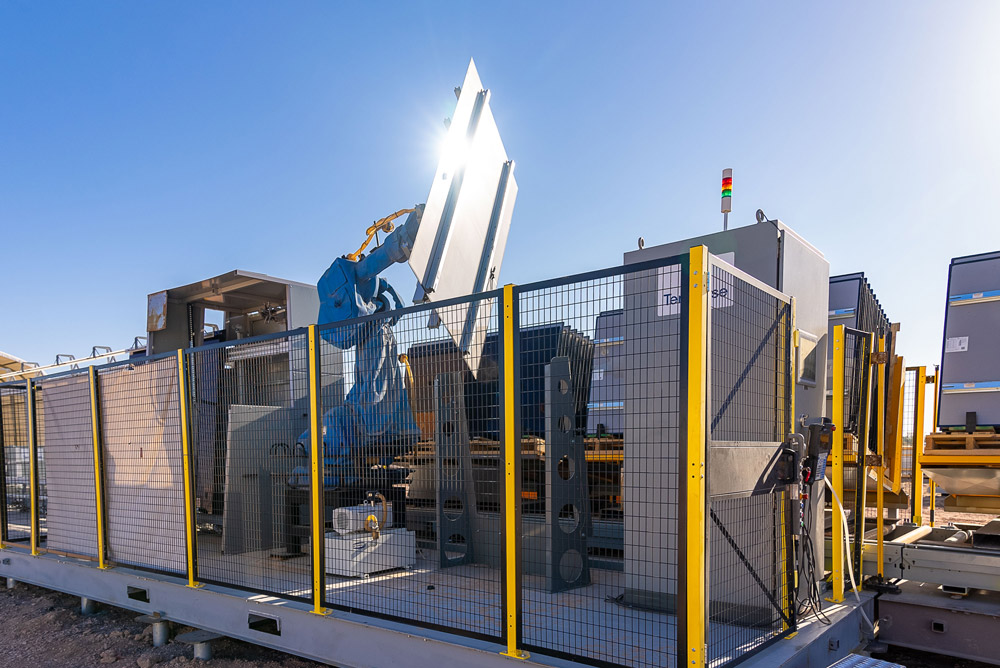
The March 19, 2026 announcement gave Terabase its most prominent technical milestone to date. V2 passed field testing. The system uses what the company describes as “physical AI”: autonomous robotics, real-time decision-making, and a Manufacturing Execution System that manages the full construction process. Robotic arms load module-tube assemblies onto rovers; workers currently perform the final placement step, with full rover autonomy described as forthcoming.
The throughput figure deserves its own paragraph. CEO Matt Campbell told pv magazine in April 2026 that V2 “could ideally place 20 MW per week per line if running continuously.” The qualifiers in that sentence, “ideally” and “if running continuously,” are doing structural work. They signal that 20 MW per week is a nameplate ceiling derived from cycle-time arithmetic, not a demonstrated operational average. No publicly available source discloses actual sustained weekly installation rates, machine uptime percentages, or utilization figures from any V1 or V2 field deployment.
Terabase’s own productivity figures do not agree with each other. Its November 2023 release on the first commercial deployment, 17 MW at White Wing Ranch, reported “labor productivity improvements of 25% compared with manual installation.” Its Terafab product page now says the system can “double installation productivity” and lists V2 at “Twice the productivity of traditional stick-build.” Both figures are measured against manual installation. 25% is the one figure measured on a named project; 2x is the figure the company now markets, and no public deployment record stands behind it. The “twice as fast” Campbell gave pv magazine USA in April 2026 is a third comparison, V2 against V1, and is not the same claim.
The 10 GW claim also has a history. When Terabase opened its Woodland, California manufacturing facility in May 2023, it stated the facility was manufacturing the first gigawatt of Terafab assembly lines with a capacity to build more than 10 GW of Terafabs per year. The identical ceiling reappears in the March 2026 V2 launch, now framed as a 12-month buildout target. The figure has remained static across the V1-to-V2 transition, a period of nearly three years during which cumulative installation reached somewhere between 40 MW and 100 MW. No public source explains what constraints kept the manufacturing ceiling constant while deployment grew, nor what specific milestones would translate 10 GW of factory capacity into 10 GW of installed annual solar output.
The company’s own schedule does not fit inside the twelve months. On April 2, 2026, two weeks after the release, pv magazine USA reported Campbell as saying “there are two deployable factories available now with a third to be ready by the end of the year”, and that he “expects 10 factories to be available in the second quarter of 2027.” At the release’s own rate of roughly 1 GW per factory per year, ten factories are the 10 GW. The claim gave that capacity twelve months, to March 2027; the roadmap reaches it in the second quarter of 2027, as much as fifteen months out. The ramp is also back-loaded: one factory added in the nine months to December, then seven in the six months after.
Ten lines on the roadmap: two in April 2026, a third by December, seven more by mid-2027
What the Commercial Record Shows
Terafab’s first deployment outside testing came in November 2023, when the system installed 17 MW of the 225 MW White Wing Ranch solar project in Arizona, in collaboration with developer Leeward Renewable Energy and EPC contractor RES. That project produced the only independently corroborated performance figures in the public record: a 25% labor productivity improvement over manual installation, elimination of manual heavy lifting, a shaded working environment in desert conditions, and 100% return of PV module packaging for reuse.
Those figures have not been replicated or superseded in any subsequent public disclosure. Deployments two through five are known to have occurred, because cumulative installed capacity rose from 17 MW to 40 MW by March 2025 and to 100 or more MW by late 2025, but the project names, locations, sizes, EPC partners, and performance outcomes for those incremental roughly 83 MW are entirely absent from the public record. PV Tech reported in March 2026 that V1 had been deployed at five projects total since its 2023 launch, a pace of approximately two projects per year.
The V2 situation is less resolved still. As of the most recent available searches, no named first commercial customer or project for Terafab V2 had been publicly announced. The March 19, 2026 launch declared V2 ready for commercial shipment, and the company’s product page states Terafab has installed 100 or more MW across commercial US projects, but no press release, customer announcement, or third-party report identifies a specific V2 project by name, size, location, or EPC partner.
Terabase has claimed 10 GW a year twice; what it delivered in between is counted in megawatts
Claimed
- 2023-0510 GW per year · Terafab-building capacity (Woodland opening)
- 2026-03-1910 GW per year · Terabase's claim: factory capacity to install promised by 2027-03
Scheduled
- 2026-123 lines · deployable Terafab V2 factories
- 2027-Q210 lines · deployable Terafab V2 lines
Delivered
- 202210 MW · original Terafab field test installed capacity
- 2023-1117 MW · installed at White Wing Ranch, first commercial deployment
- 2025-0340 MW · Terafab cumulative installed capacity
- 2026-02100 MW · Terafab cumulative installed capacity
- 2026-042 lines · deployable Terafab V2 factories
Tells ahead
- 2026-12-31Commercial building permits or FERC interconnection queue filings naming a V2…
- 2026-12-31First Solar quarterly earnings disclosures showing Series 7 shipment volumes…
- 2026-12-31At least three deployable Terafab V2 lines by December 31, 2026, confirmed by…
- 2027-03-31Terabase cumulative installed capacity reaching 500 MW or more by December…
- 2027-06-30FERC interconnection queue data in CAISO, MISO, and ERCOT showing a pipeline…
- 2027-06-30Ten deployable Terafab V2 lines by June 30, 2027, the company's own roadmap…
Financials: Capital Behind the Claim
Terabase has raised over $200 million in total funding. The Series C round of $130 million, led by SoftBank Vision Fund 2 and closed on March 13, 2025, was explicitly earmarked in large part for manufacturing scale-up of Terafab, with a stated goal of deploying hundreds of megawatts of solar through 2026. Prior rounds include a $44 million Series B in August 2022 co-led by Breakthrough Energy Ventures and Prelude Ventures, a $25 million round in July 2023 led by Fifth Wall, a $6 million Series A in September 2020, and a $2 million seed in November 2019.
Terabase Energy: Cumulative Capital Raised
No revenue or profitability figures have been publicly disclosed. The company has not released financial statements, and no reputable press source has published verified revenue or burn rate data. The only operational revenue-generating metric in the public domain is the cumulative 40 MW figure cited at the Series C, later updated to 100 or more MW on the product page. No valuation has been disclosed in any funding announcement.
The capital trajectory is coherent with the manufacturing ambition: the $130 million Series C is large enough to fund serious robotics manufacturing at scale. Whether it is sufficient for 10 deployable lines by Q2 2027 depends on per-unit capital costs that Terabase has not disclosed publicly.
Technology: The Outdoor Line and Its Demands
Terafab inverts conventional solar construction. Rather than driving piles and torque tubes into the ground and manually attaching panels on-site, the system pre-assembles modules onto tracker torque tubes in an outdoor assembly line with in-line quality control that catches defects at the point of assembly. Purpose-built rovers then deliver pre-assembled components to their final installation points in the field.
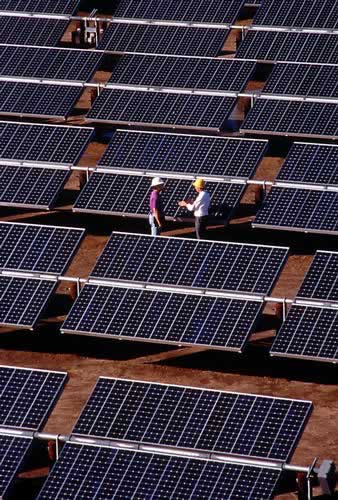
The V2 system is optimized for First Solar Series 7 panels and Nextracker trackers. Robotic arms load approved module-tube assemblies onto unmanned rovers; workers currently perform the final manual placement step. The company describes rovers as soon to operate fully autonomously, but no date or technical specification for that transition is in the public record.
The outdoor operating environment is the core engineering challenge this approach accepts. Terabase describes investing years of R&D to achieve factory-grade precision year-round across desert dust, triple-digit heat, wind, rain, and mud. That claim is credible as an engineering objective; it is unverified as an achieved operational standard across multiple climate regimes and seasons, given the limited and geographically concentrated deployment record.
The competitive frame includes Built Robotics, whose autonomous pile-driving robot drives a pile every 73 seconds and has been adopted by Quanta Services subsidiary Blattner for solar projects. Built Robotics addresses a different step in the construction sequence, pile driving rather than module assembly and placement, which means the two systems are potentially complementary rather than directly substitutable. On the software side, Terabase’s Construct platform was supporting more than 25 GW of projects worldwide as of April 2026, including EDP Renewables surpassing 2 GW managed on Construct, though that GW-supported metric represents projects managed by the software, not installed by Terafab.
Team and Organization
Terabase was co-founded in 2019 by six veterans of SunPower: CEO Matt Campbell, Chris Baker, Amine Berrada, Dan Cohen, Pierre Gousseland, and Thang Le. Campbell spent 15 years at SunPower in project development, manufacturing, and operations, including roles as VP of Global Power Plants and VP of Power Plant Products. He left when SunPower pivoted away from utility-scale solar in 2019.
Co-founder Pierre Gousseland, now SVP of Construction Technology, led global sales and development engineering for SunPower’s Power Plant business unit and oversaw EPC of roughly 2 GWp of projects, including the 747 MW Solar Star project in California. EVP of Plant Operational Technology Mahesh Morjaria co-founded REPlantSolutions and led utility-scale solar R&D and grid integration at First Solar for nearly a decade before joining Terabase. VP of Software Allan Daly was previously co-founder of BrightBox Technologies and VP of Software at Nextracker, the tracker supplier whose hardware V2 is currently optimized for.
The team’s collective background spans more than 250 projects in 20 or more countries, representing over 5 GW and $10 billion of investment since 2007, according to the company’s own team page. Headcount estimates diverge across sources: the company profile on BusinessWire’s page for the March 2026 release lists 200 employees, PitchBook lists 188 in its most recent data pull, and The Org’s org chart tracked 167 positions when this research ran. TheOfficialBoard’s September 2025 update lists 43 leaders. A job listing on Built In, as of mid-2026, sought a Head of Terafab Field Operations charged with defining the operating model, hiring for multi-shift deployments, and building out field operations, signaling that the operational leadership layer for scale-up was still being assembled.
Market Context
The structural tailwind is real. US utility-scale solar installed a record 41.4 GW in 2024, followed by 34.7 GW in 2025, with solar accounting for 54% of all new US electricity-generating capacity added that year. Wood Mackenzie forecasts 356 GWdc of new US utility-scale solar capacity between 2025 and 2035. Against that volume, a workforce gap is acute: 86% of solar employers report difficulty hiring, and a projected shortfall of 53,000 positions threatens 2026 deployment targets.
That workforce gap is the structural argument for what Terabase is building. If Terafab can deliver 25% or more labor productivity improvement at scale and across varied site conditions, the value proposition writes itself against a market that cannot hire fast enough to meet its own installation targets. The data-center and AI electricity demand surge, which Terabase itself cites in its press materials, is accelerating that dynamic.
Construction robotics venture funding reached $1.36 billion in the first three quarters of 2025 alone, more than double the $612 million invested across all of 2024, according to the 2026 Construction Robotics Report from Zacua Ventures, Hilti Ventures and 94 Ventures, signaling a competitive funding environment maturing around the segment Terabase occupies.
The Binding Constraint
The binding constraint on the 10 GW claim is not engineering at the cycle-time level. A two-minute cycle time is plausible for a robotic assembly line handling standardized panels and trackers. The binding constraint is fleet expansion at operational utilization: converting a Northern California factory’s manufacturing capacity for Terafab units into ten or more lines that are simultaneously deployed on project sites, running at a utilization rate that approaches the theoretical maximum, with a customer pipeline deep enough to keep them moving from site to site without extended idle periods between project mobilizations.
The release itself names why utilization is the open question: “Factory automation has been widely demonstrated indoors, where conditions are controlled and predictable. Terafab operates in an entirely different outdoor environment.” The 20 MW-per-week nameplate is a factory figure, derived from a cycle time. The utilization a line sustains is set by the outdoor site it runs on, and no deployment has published how much of the nameplate survives weather, moves between field zones, and gaps in module delivery.
This matters because the 10 GW figure is a product of factory throughput multiplied by the number of lines simultaneously in the field, each running continuously. As of April 2026, two lines existed. Getting to ten by Q2 2027 requires both manufacturing those units and contracting the EPC projects that would absorb them. The latter is not a manufacturing problem; it is a sales, contracting, and project-development problem, and the pace of V1 commercial deployment, roughly two projects per year across a single line’s worth of capacity, does not yet demonstrate the commercial velocity required.
What would have to change for this constraint to stop binding: a visible pipeline of signed EPC contracts committing Terafab V2 lines to specific projects with specific installation windows, combined with disclosed utilization data from the first V2 commercial deployments showing sustained throughput near the 20 MW-per-week ceiling. The manufacturing capacity at Woodland may well be buildable, though the company’s own ramp puts it at as much as fifteen months rather than twelve. Filling it with contracted demand and sustaining the lines at operational utilization is the undemonstrated step.
What Would Change This
Evidence that would increase confidence in the claim: signed contracts with named EPC partners committing specific V2 lines to specific projects with installation windows inside the 12-month target; disclosed weekly installation rates from the first V2 commercial deployment showing sustained throughput materially above V1’s pace; and a public accounting of the contracted project pipeline that would absorb ten lines of capacity simultaneously.
Evidence that would decrease confidence: V2 commercial deployments that report sustained throughput significantly below the 20 MW-per-week nameplate, extended inter-project idle periods that compress effective annual utilization, fewer than three deployable lines by December 31, 2026, or the tenth line slipping past the second quarter of 2027.
Observables
Six specific tells will surface in the public record without requiring Terabase’s cooperation.
The first and most immediate: commercial building permits and conditional use permits for utility-scale solar projects in the United States are public records at the county or state level. A V2 deployment requires a project at a specific site with an EPC contractor of record. Any Terafab V2 commercial deployment in the United States will be associated with a permitted project site that can be identified through county permit databases or FERC interconnection queue filings, most likely by Q4 2026.
The second: FERC interconnection queue data, published on the FERC website and updated monthly, lists projects by developer, capacity, and expected commercial operation date. A pipeline of Terafab-enabled projects large enough to absorb 10 GW of annual installation capacity would be visible in the interconnection queues of the relevant ISO/RTO regions, particularly CAISO, MISO, and ERCOT, with commercial operation dates clustering in the 2026 to 2028 window. This data is updated monthly and requires no company disclosure.
Third: First Solar’s annual manufacturing output and shipment disclosures, published in its quarterly earnings reports, constrain the module supply available to Terafab V2, which is currently optimized exclusively for First Solar Series 7 panels. That supply is already committed years ahead: First Solar ended the second quarter of 2026 with approximately 45.1 GW of contracted backlog extending through 2030. If First Solar’s disclosed shipment volumes do not support the project volumes implied by 10 GW of annual Terafab installation, the module supply becomes a co-binding constraint. First Solar’s next two quarterly earnings releases, expected Q3 and Q4 2026, will carry this data.
The claim beside its only supplier's entire 2026 output
Fourth: Terabase’s own Series C commitment to “deploy hundreds of megawatts of solar through 2026” is testable against the 100-plus MW figure already on the company’s product page as of late 2025 or early 2026. If cumulative installed capacity reaches 500 MW or more by December 2026, that would be consistent with V2 ramping toward multi-line deployment. If it remains below 200 MW, the gap between nameplate and operational throughput is likely larger than the 12-month 10 GW claim can bridge. Industry trade press including PV Tech and pv magazine USA track cumulative deployment figures and publish them without requiring Terabase cooperation, typically within one to two quarters of project completions.
Two further tells resolve the capacity verdict directly. At least three deployable Terafab V2 lines by December 31, 2026, confirmed by company disclosure or trade press. Ten deployable lines by June 30, 2027, the company’s own roadmap date, confirmed the same way.
New research by email. Roughly one piece a month.
Sources (43)
- TERABASE
Terabase Secures $130 Million Series C from SoftBank Vision Fund 2 to Accelerate Construction of Utility-Scale Solar | Terabase Energyterabase.energy
- TERABASE
Terabase Raises $25M to Accelerate its Digital and Automation Solutions | Terabase Energyterabase.energy
- TERABASE
- PV-MAGAZINE-USA
Terabase Energy raises funding to break the $0.01/kWh utility-scale solar barrier with software - pv magazine USApv-magazine-usa.com
- POWERHOUSE
Terabase | Powerhousepowerhouse.fund
- PITCHBOOK
Terabase 2026 Company Profile: Valuation, Funding & Investors | PitchBookpitchbook.com
- THEORG
Terabase Energy Org Chart - The Orgtheorg.com
- TERABASE
Terabase Energy Acquires PlantPredict Utility-Scale Solar Energy Modeling Tool from First Solar | Terabase Energyterabase.energy
- TERABASE
Terabase Energy's Next-Generation Terafab® Completes Field Testing, Ready for Deployment | Terabase Energyterabase.energy
- BUSINESSWIRE
Terabase Energy's Next-Generation Terafab® Completes Field Testing, Ready for Deployment - BusinessWirebusinesswire.com
- SOLARPOWERWORLDONLINE
Terabase automated solar construction platform is ready for its full market debut - Solar Power Worldsolarpowerworldonline.com
- TERABASE
Terafab Solar Construction Automation | Terabase Energyterabase.energy
- TERABASE
Terabase Energy Launches Terafab® Automated Field Factory to Accelerate the Deployment of Solar Power Plants | Terabase Energyterabase.energy
- PV-MAGAZINE-USA
Terabase Energy invests in automation and engineering to streamline solar construction - pv magazine USApv-magazine-usa.com
- PV-MAGAZINE
Terabase Energy advances automated PV construction with robotics, AI tools - pv magazine Globalpv-magazine.com
- ENERGY
Success Story—Putting Solar Energy Installation on Autopilot | Department of Energyenergy.gov
- RENEWABLEENERGYWORLD
Solar installation automation platform sees first successful deployment - Renewable Energy Worldrenewableenergyworld.com
- TERABASE
Terabase Energy Named to Fast Company's Annual List of the World's Most Innovative Companies of 2026 | Terabase Energyterabase.energy
- PLANTPREDICT
PlantPredict | Bankable Solar Energy Modeling Software by Terabase Energyplantpredict.com
- TERABASE
Terafab construction automation wins GOLD at 2024 Edison Awards | Terabase Energyterabase.energy
- TERABASE
Terabase Energy Named on the 2026 Global Cleantech 100 | Terabase Energyterabase.energy
- SEIA
Solar Market Insight Report 2025 Year in Review - SEIAseia.org
- SEIA
Solar Market Insight Report 2024 Year in Review - SEIAseia.org
- UTILITYDIVE
Utility-scale US solar installations to surpass 32 GW for record high in 2024: ACP | Utility Diveutilitydive.com
- SEC
- PV-MAGAZINE-USA
Workforce gap of 53,000 threatens 2026 solar deployment targets - pv magazine USApv-magazine-usa.com
- IRECUSA
Census Workforce Development - Interstate Renewable Energy Council (IREC)irecusa.org
- BUILTROBOTICS
Press - Built Roboticsbuiltrobotics.com
- BUSINESSWIRE
Terabase Energy Accelerates International Expansion as Construct Platform Surpasses 2 GW with EDP Renewables - BusinessWirebusinesswire.com
- TERABASE
Solar Construction Software & Install Automation | Terabase Energyterabase.energy
- TERABASE
Terabase Energy Completes First Commercial Deployment of Terafab Solar Construction Automation System | Terabase Energyterabase.energy
- PV-TECH
Terabase completes testing of Terafab V2, technology 'ready' for commercial sales - PV Techpv-tech.org
- SOLARBUILDERMAG
Terabase Energy Launches Terafab® Automated Field Factory - Solar Buildersolarbuildermag.com
- PV-MAGAZINE-USA
Utility-scale solar installation goes automated - pv magazine USApv-magazine-usa.com
- TERABASE
Meet the Team | Terabase Energyterabase.energy
- SJFVENTURES
SJF Ventures Leads Terabase Series A - SJF Venturessjfventures.com
- THEOFFICIALBOARD
Terabase Energy Org Chart + Executive Team - TheOfficialBoardtheofficialboard.com
- BUILTIN
Terabase Energy Jobs + Careers | Built Inbuiltin.com
- TERABASE
Careers | Terabase Energyterabase.energy
- SOLARINDUSTRYMAG
Terabase Partners with Leeward, RES on White Wing Ranch Installation - Solar Industrysolarindustrymag.com
- PV-TECH
Terabase deploys Terafab construction automation system at Arizona solar farm - PV Techpv-tech.org
- ELECTREK
A 24/7 solar farm-building robot just hit the market | Electrekelectrek.co
- ZACUAVENTURES
Construction Robotics Report 2026 - Zacua Ventures, Hilti Ventures and 94 Ventureszacuaventures.com