
Executive summary
On June 4, 2026, Antares Nuclear’s Mark-0 reactor reached zero-power fueled criticality at Idaho National Laboratory’s Reactor and Critical Experiment facility, one month ahead of the deadline set by Executive Order 14301. The dates first appeared as “as early as” in December 2025 and became firm by June 2026. The record on the first commitment is clean.
The next commitment is electricity from the Mark-1 reactor in 2027. That step requires three things the Mark-0 demonstration did not need and did not test: a new safety basis covering power operation, a qualified power conversion system, and a reliable fuel supply chain. Two of those three are materially advanced. The safety basis is the one that binds.
The claim examined
Jordan Bramble, CEO and co-founder of Antares, stated on June 4, 2026: “We said criticality in 2026, electricity production in 2027, and power to the warfighter in 2028.” The same dates appear in his written congressional testimony and in the company’s Series C press release. Earlier statements were softer: in December 2025 the company put electricity “as early as 2027”. Since criticality, the dates have not been publicly revised.
The first leg delivered. The second and third are what this article examines.
Antares met the first of its three dates; the safety-basis approval the second needs has not been announced
Claimed
- 2025-12Criticality 2026, electricity 2027, deployment as early as 2028
- 2026-06-04Said: criticality 2026, electricity 2027, warfighter power 2028
Scheduled
- 2027Mark-1 produces electricity at INL
- 2028First deployments to defense customers
Delivered
- 2026-01-26DOE approves the Mark-0 preliminary safety analysis
- 2026-04-06DOE approves the Mark-0 full safety analysis (DSA)
- 2026-06-04Mark-0 reaches zero-power criticality at INL
- 2026-08-27TRISO fuel agreement with Standard Nuclear, through 2035
- 2026-09-17Multi-year HALEU contract with Centrus
Tells ahead
- February 2027A Mark-1 safety-basis approval announced (PDSA or DSA)
- Q1 2027EDU-2 power conversion test completion announced
- Q1 2027Centrus filings show any change to HALEU delivery terms
- Q2 2027DOE approval of the Mark-1 full DSA announced
What Mark-0 actually proved, and what it did not
The Mark-0 is a sodium heat-pipe-cooled microreactor fueled by HALEU TRISO compacts in a prismatic graphite core, with control drums modeled on historical space reactor designs. It was built as a physics validation platform. It has no power conversion loop and no heat-sink systems. Its approval pathway ran under DOE Standard 1271, a streamlined process that bypasses NRC licensing for the initial test phase.
The DOE approved a Preliminary Documented Safety Analysis in January 2026, a full Documented Safety Analysis in April 2026, and conducted a Readiness Review before clearing the June 4 startup. Antares was the first company to receive an approved Nuclear Safety Design Agreement for a reactor under this framework.
On June 4, the reactor went critical. The DOE’s own press release stated the test “establishes a basis that would allow subsequent reactors to produce electricity in 2027 and beyond.” A basis is not an authorization. The Mark-0 DSA covers a zero-power configuration; it says nothing about the power conversion system, about full-power heat removal, or about the coupled behavior between the reactor core and the turbomachinery that Mark-1 must demonstrate.
Two other Reactor Pilot Program companies reached DOE-authorized criticality by the July 4 deadline, according to the program’s own record: Valar Atomics, whose Ward 250 DOE announced on June 18, and Aalo Atomics, whose Aalo-X went critical early on July 4 and was announced July 6. A fourth reactor, Deployable Energy’s Unity, went critical on June 30 under a separate DOE initiative, the Nuclear Energy Launch Pad, and DOE counted it as the third toward the executive order’s goal. Antares was first by two weeks, and the record confirms it. The competitive significance of being first within the cohort is real, but three program companies completing zero-power tests means three companies now face the same next step.
The three prerequisites for 2027 electricity
Safety basis. No Mark-1 safety-basis approval, preliminary or full, has been announced as of October 2026, and whether one is under review is not public: for Mark-0 the approvals were announced, not the submissions. The Mark-0 documentation does not cover full-power operation, power conversion integration, or heat removal under load. Antares’s own roadmap lists “closing the final reactor design and safety analysis” as 2026 work, so a Mark-1 analysis may be in preparation or review now. The DOE Standard 1271 process runs in sequence: a preliminary analysis, a full documented safety analysis, a readiness review, then startup authorization. For Mark-0, the announced approvals ran from the preliminary analysis on January 26, 2026 to the full analysis on April 6 and criticality on June 4, about four months. A Mark-1 sequence of similar length would have to finish by mid-2027 to leave room for the six months of electricity production the company plans within 2027.
Power conversion system. The R1’s conversion architecture uses a recuperated nitrogen closed Brayton cycle operating at less than 300 psi. Bramble stated on June 4, 2026, that the company had “completed over 6 months of full-power thermal testing in an electrical prototype” (EDU-1) and planned a second round in 2026. POWER Magazine’s post-criticality analysis confirmed that non-nuclear thermal testing “requires no regulatory process and allows disassembly for material inspection between runs” and is the likely vehicle for closing out heat pipe, heat exchanger, and power conversion system qualifications. No completion announcement for EDU-2 or formal qualification of the power conversion system has been publicly disclosed. The thermal testing program is the right approach and the company appears to be executing it; the gap is that the public record does not confirm it is finished.
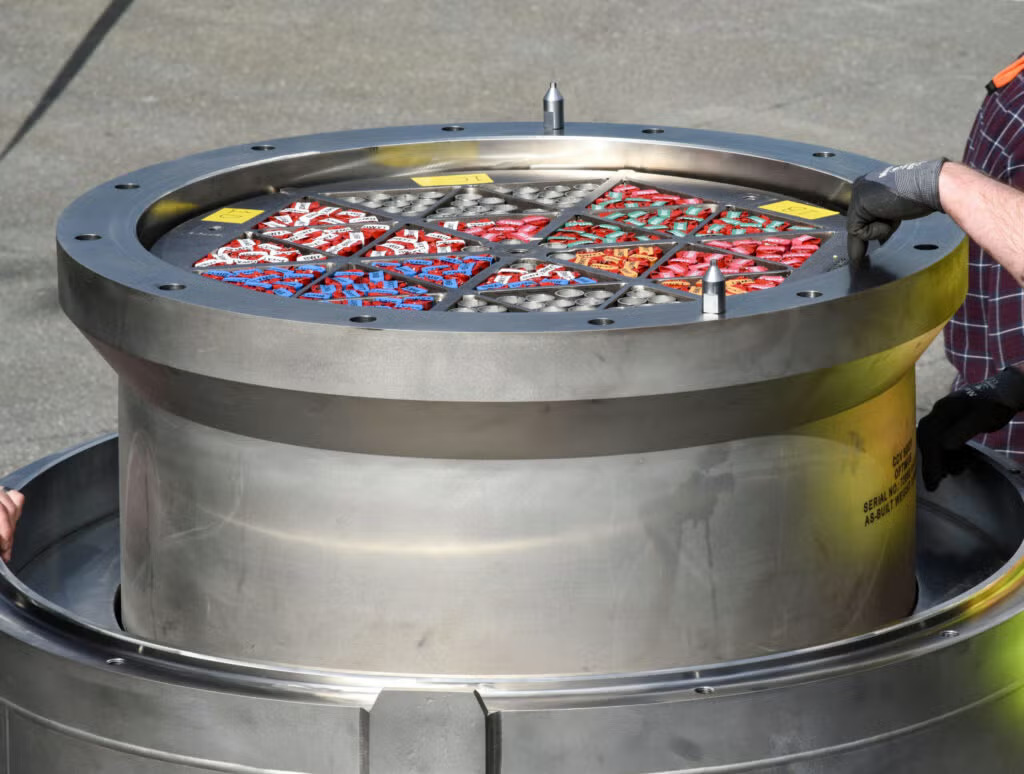
Fuel supply. This is the area where Antares has moved most visibly since criticality. TRISO fuel for Mark-0 and Mark-1 is fabricated by BWX Technologies at its Lynchburg, Virginia facility, using DOE-allocated HALEU from NNSA scrap materials. The DOE NEPA document specifies up to 200 kg of uranium in TRISO form for the demonstration. On August 27, 2026, Antares signed a multi-year fuel supply agreement with Standard Nuclear for a minimum of 1 MTU and up to 8 MTUs of TRISO fuel through 2035. For HALEU, Antares has signed three agreements: a long-term enrichment-services agreement with Urenco on May 21, 2026, to be supplied from a UK facility scheduled to come online in 2031; a multi-year agreement with General Matter on July 2, 2026 for several metric tons of HALEU from Paducah, Kentucky, announced by Antares; and, on September 17, 2026, a multi-year HALEU supply contract with Centrus Energy, which operates the only licensed HALEU production facility in the western world. The Standard Nuclear and Centrus agreements are SEC-filed. The fuel for Mark-1 is further along than the other two prerequisites. For the 2028 deployments, no agreement yet states a delivery date.
The binding constraint
The Mark-1 safety basis is the binding constraint on the 2027 electricity commitment.
The power conversion system can be tested non-nuclearly and improved without regulatory interaction; that work can proceed in parallel and on a faster cycle. Mark-1’s fuel is already in hand. Neither of those two prerequisites waits on a sequential regulatory approval.
The Mark-1 DSA does. DOE Standard 1271 requires a new Preliminary Documented Safety Analysis, a new full Documented Safety Analysis, and a DOE Readiness Review before startup authorization is granted for a configuration that differs materially from the approved Mark-0. A reactor integrated with a power conversion system, operating above zero power, presents a fundamentally different safety envelope: temperature-dependent reactivity feedback, coupled thermal-hydraulics between the core and the Brayton loop, heat removal under transient conditions. The safety analysis must address all of it. The Mark-0 DSA does not.
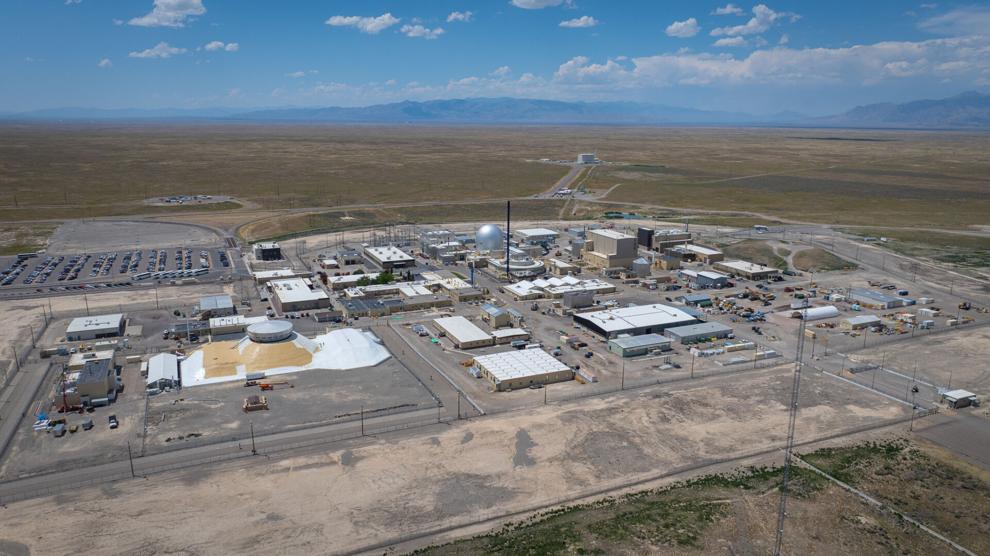
For Mark-0, the announced approvals ran about four months from the preliminary analysis (January 26, 2026) to criticality (June 4), and that was for a zero-power configuration with a simpler safety envelope. For Mark-1, no approval has been announced, and whether an analysis is under review is not public. If the Mark-1 sequence runs as long as Mark-0’s, its preliminary approval has to come by February 2027 to leave room for a 2027 electricity test of more than six months, as the company’s own roadmap specifies.
What would have to change for this constraint to stop binding: an announced DOE approval of a Mark-1 preliminary safety analysis, followed by the full analysis and a readiness review on a schedule consistent with a 2027 test start. The constraint is the sequence of approvals, and the public record for Mark-1 does not yet show the first one.
The capital and the contracts
Antares Nuclear: Cumulative Capital Raised
Antares raised $470 million in a Series C on July 27, 2026, structured as $370 million in equity and $100 million in debt, co-led by Paradigm and Caffeinated Capital, bringing total disclosed funding to over $604 million since the company’s 2023 founding. The post-money valuation was approximately $2.06 billion according to Forge Global, derived from Series C share pricing data, though that figure carries moderate confidence given the derivation method.
The Series C press release stated the capital funds “the path from a demonstrated reactor to fielded systems,” specifically naming Mark-1 electricity production in 2027 and defense deployments in 2028. The capital is not the constraint. Before the Series C closed, Tectonic Defense reported that Antares achieved Mark-0 criticality with roughly $134 million raised, “the least amount of capital out of the RPP cohort.” The question for the power phase is whether regulatory sequencing, not funding, determines the pace.
Government contract backlog provides additional runway. CEO Bramble stated in August 2026 that combined Army, Air Force, and Space Force contract value is “on the order of $1 billion” and growing. In April 2026, the Air Force selected Antares for deployment at Joint Base San Antonio under ANPI, one of three vendor-site pairings from an original pool of eight. In August 2026, the Army selected Antares under Project Janus for Fort Bragg. In September 2026, the Space Force awarded a $161 million Strategic Breakthrough contract for the R1-S space reactor variant. The agreements pay on milestones, and they show that three separate armed services have made program commitments contingent on Antares delivering.
The team assembled for the next phase
Jordan Bramble co-founded Antares with Julia DeWahl in 2023; his background spans systems engineering, White House OMB, and the restaurant-tech startup Local Kitchens.
The hire that most directly addresses the Mark-1 safety basis gap is Dr. Rian Bahran, who joined as Chief Nuclear Officer on July 28, 2026, immediately after leaving the Department of Energy. He served as DOE Deputy Assistant Secretary for Nuclear Reactors, overseeing the federal portfolio for advanced reactor research and deployment. He previously held roles at Los Alamos National Laboratory as experimentalist and program manager, as Assistant Director for Nuclear Technology and Strategy at the White House OSTP, and as a senior defense policy advisor. He received a Secretary of Energy Achievement Award for the Reactor Pilot Program before departing. Bramble’s stated rationale: “Rian has spent his career at every layer of this problem: the experiment, the policy, and the program. As we move from criticality to commercialization, his expertise is exactly what this team needs.”
The framing is accurate to Bahran’s record. The DOE Standard 1271 process that governs Mark-1 authorization is one he administered from the government side. Whether that familiarity translates into a faster approval sequence depends on the DOE’s own review process, which the government controls. His presence makes the case that the company understands what the process requires. It does not accelerate the process itself.
Headcount roughly doubled between the December 2025 Series B close, when about 60 employees were reported, and August 2026, though third-party trackers disagree on the exact count. The Antares Prime facility in Torrance, California expanded from 145,000 square feet at the Series B close to 322,000 square feet as reported on the company’s website after the Series C, with no separate announcement of the expansion identified.
Market position
The defense microreactor segment is converging on a 2028 deployment deadline established by executive order. Within the DOE Reactor Pilot Program’s original cohort of 10 companies supporting 11 reactor designs, three reached criticality by the July 4 deadline (Antares, Valar Atomics and Aalo Atomics). Within the ANPI program’s original pool of eight vendors, three were down-selected in April 2026. Antares is in both sets of three.
Among ANPI down-selects, Antares holds the deepest combination of defense contract depth and demonstrated reactor progress
Radiant Industries, the most direct comparable, has raised over $460 million including a $300 million Series D in December 2025, holds a binding Equinix pre-order for 20 units of its 1.2 MW Kaleidos reactor, and is building a factory in Oak Ridge targeting 50 reactors per year. Radiant was also selected in the ANPI down-select, paired with Buckley Space Force Base. Its production ambition is larger than Antares’s stated 10 units per year target, though neither company has yet produced a commercial unit. Project Pele, the government-owned BWXT prototype, originally targeted 2025 operation and has slipped to a 2028 alignment, which puts it in competition with rather than ahead of the commercial startups.
The NRC pre-application engagement Antares began in May 2025 (Docket 99902149) with a Regulatory Engagement Plan filed July 2025 is the parallel track for any non-DOE-regulated commercial deployment. That process is separate from the DOE Standard 1271 authorization governing the INL tests. The Army’s Janus deployment at Fort Bragg and the Air Force deployment at JBSA each carry their own siting, licensing, and environmental review requirements under different regulatory frameworks. None of those downstream approvals is imminent, and none has been initiated publicly.
What would change this assessment
Additional evidence that would increase confidence in the 2027 electricity commitment: an announced DOE approval of a Mark-1 preliminary safety analysis under DOE Standard 1271; a public announcement completing EDU-2 power conversion system qualification; and a confirmed test slot at INL’s MFC-793 facility for Mark-1 in early-to-mid 2027.
Evidence that would reduce confidence: no Mark-1 safety-basis approval announced by February 2027, which would compress or eliminate the margin for a six-month electricity test within that year; a failure mode identified in EDU-2 thermal testing that requires redesign; or a DOE programmatic decision to sequence Mark-1 authorization behind other RPP participants’ needs at the same facility.
The 2028 deployment commitment involves additional variables: NRC or Army regulatory review (depending on the installation and legal framework), site preparation, environmental assessment, and fuel delivery at each installation. The record contains no public filings on any of those steps as of the research date. On August 28, 2026, DOE selected Antares for the Nuclear Energy Launch Pad, a DOE authorization path for operating reactors beyond the national laboratories, which bears on where and under whose authority a 2028 deployment could run.
Observables
A DOE approval of a Mark-1 Preliminary Documented Safety Analysis under DOE Standard 1271 will be announced, as both Mark-0 approvals were (Antares, January 26 and April 6, 2026, carried by ANS Nuclear Newswire, POWER Magazine and Nuclear Engineering International). Submissions are not normally public, so the approval is the checkable event. Mark-0 ran 129 days from preliminary approval to criticality, so a six-month test inside 2027 needs the Mark-1 preliminary approval by late February. Announced by February 2027, it leaves room for a 2027 electricity test; absent by then, a Mark-0-length sequence leaves less than six months of 2027 for the test.
The full Mark-1 DSA approval will follow and be announced the same way, with the approval date and the approved document named. The gap between the Mark-0 preliminary and full approvals was about ten weeks (January 26 to April 6, 2026). A comparable gap for Mark-1 is the minimum planning assumption.
The EDU-2 power conversion system test completion, if announced, will appear in a company press release carried by BusinessWire and confirmed in ANS and POWER Magazine coverage, consistent with the pattern for every other Antares milestone. Absence of such an announcement by Q1 2027 would indicate the PCS qualification remains open.
The Centrus 8-K, already filed with the SEC, confirms the HALEU supply agreement’s existence and structure. Any material amendment or delivery schedule update will appear in subsequent Centrus quarterly filings, which are public.
New research by email. Roughly one piece a week.
Sources (58)
Disclosure: the author is an engineer at a DOE national laboratory and has no involvement with the Reactor Pilot Program; this piece draws only on the public record.
- ENERGY
Department of Energy Celebrates First Advanced Reactor Criticalityenergy.gov
- BUSINESSWIRE
Antares Achieves Initial Criticality of a Privately Developed Advanced Reactor Under DOE Pilot Program – BusinessWirebusinesswire.com
- ARMY
Department of Energy and U.S. Army reach a major milestone on advanced microreactorsarmy.mil
- POWERMAG
- BUSINESSWIRE
Antares Receives DOE Preliminary Document Safety Approval for Mark-0 Demonstration Reactor – BusinessWirebusinesswire.com
- POWERMAG
Antares Receives DOE Approval of Mark-0 Demonstration Reactor – POWER Magazinepowermag.com
- ANS
Aalo and Antares progress on Reactor Pilot Program – ANS Nuclear Newswireans.org
- ANS
The deadline arrives: Checking in on the Reactor Pilot Program – ANS Nuclear Newswireans.org
- NRC
Office of Nuclear Energy Reactor Pilot Program Update – NRC.govnrc.gov
- BUSINESSWIRE
Antares Raises $470M Series C to Deploy Nuclear Microreactors for Critical Missions – BusinessWirebusinesswire.com
- YAHOO
Antares Raises $470M Series C to Deploy Nuclear Microreactors for Critical Missions – Yahoo Financefinance.yahoo.com
- BUSINESSWIRE
Antares Raises $96 Million in Series B Funding – BusinessWirebusinesswire.com
- TECHCRUNCH
Microreactor startup Antares raises $96M – TechCrunchtechcrunch.com
- ANS
Antares raises funds for microreactor development – ANS Nuclear Newswireans.org
- CROWELL
Crowell Represents Nuclear Energy Startup Antares Industries in $30M Series Acrowell.com
- SILICONLEGAL
SLS Client Caffeinated Capital Co-Leads Antares' $30M Series A Round – Silicon Legalsiliconlegal.com
- SEC
CENTRUS ENERGY CORP – Form 8-K Exhibit – FY2026 – SEC EDGARsec.gov
- SEC
Standard Nuclear Announces Fuel Supply Agreement with Antares Nuclear – SEC filingsec.gov
- WORLD-NUCLEAR-NEWS
Antares, Centrus sign multi-year HALEU contract – World Nuclear Newsworld-nuclear-news.org
- BUSINESSWIRE
Dr. Rian Bahran Joins Antares as Chief Nuclear Officer – BusinessWirebusinesswire.com
- YAHOO
Dr. Rian Bahran Joins Antares as Chief Nuclear Officer – Yahoo Financefinance.yahoo.com
- EXCHANGEMONITOR
Bahran leaves DOE, joins Antares Nuclear as CNO – Exchange Monitorexchangemonitor.com
- MILKENINSTITUTE
Jordan Bramble – Milken Institute Global Conference 2026milkeninstitute.org
- HOUSE
Energy Subcommittee Hearing – Powering the Nuclear Renaissance – Jordan Bramble written testimonyrepublicans-science.house.gov
- ANTARESINDUSTRIES
Antares Nuclear: Leadership Team – antaresindustries.comantaresindustries.com
- ANS
Air Force selects three microreactor developers for ANPI – ANS Nuclear Newswireans.org
- BUSINESSWIRE
Antares Selected for Proposed Deployment of Nuclear Microreactor at Joint Base San Antonio – BusinessWirebusinesswire.com
- POWERMAG
Air Force ANPI Picks Put Radiant, Antares, Westinghouse on Track – POWER Magazinepowermag.com
- BREAKINGDEFENSE
Department of Air Force picks bidders for nuclear microreactors – Breaking Defensebreakingdefense.com
- BREAKINGDEFENSE
DIU selects 8 'eligible' companies for nuclear microreactors – Breaking Defensebreakingdefense.com
- AXIOS
Exclusive: Why Antares is bringing nuclear power to Fort Bragg – Axiosaxios.com
- BIZFAYETTEVILLE
Antares awarded Army Janus Program agreement – Biz Fayettevillebizfayetteville.com
- ANS
DOD funds $161 million space reactor award – ANS Nuclear Newswireans.org
- SPACENEWS
U.S. Air Force awards Antares $161 million to advance nuclear reactor for space – SpaceNewsspacenews.com
- PAYLOADSPACE
Antares Wins $161M Award for Space Nuclear Power – Payload Spacepayloadspace.com
- WORLD-NUCLEAR-NEWS
First criticality for US microreactor under DOE programme – World Nuclear Newsworld-nuclear-news.org
- NEIMAGAZINE
Antares' reactor meets DOE milestone – Nuclear Engineering Internationalneimagazine.com
- NEIMAGAZINE
Safety approval for Mark-0 reactor – Nuclear Engineering Internationalneimagazine.com
- ENERGY
DOE-ID NEPA CX Determination: Antares Reactor Supportid.energy.gov
- NRC
Antares Nuclear, Inc. – NRC Pre-Application Activitiesnrc.gov
- TECTONICDEFENSE
Antares Raises $470M to Field Military-Focused Microreactors – Tectonic Defensetectonicdefense.com
- TECTONICDEFENSE
Antares Nuclear Moves Into 'Final Innings' in Race to Switch on Microreactor – Tectonic Defensetectonicdefense.com
- FORGEGLOBAL
Antares Nuclear IPO Timeline and Financing Details – Forge Globalforgeglobal.com
- DATACENTERDYNAMICS
Equinix-backed microreactor firm Radiant raises $300m – Data Center Dynamicsdatacenterdynamics.com
- CTVC
- ANS
Project Pele progress: BWXT delivers fuel to INL – ANS Nuclear Newswireans.org
- NUCNET
US Army Announces Nine Sites For Possible Microreactor Deployment – NucNetnucnet.org
- WORLD-NUCLEAR-NEWS
US Air Force announces selections for microreactor deployments – World Nuclear Newsworld-nuclear-news.org
- INL
Antares Archives – NRIC, Idaho National Laboratorynric.inl.gov
- ANTARESINDUSTRIES
Antares Nuclear – antaresindustries.comantaresindustries.com
- WASHINGTONTECHNOLOGY
Antares fetches $470M to move on military base reactor push – Washington Technologywashingtontechnology.com
- RUNTIMEWIRE
Army selects Antares to build and operate Fort Bragg microreactors in $2.2B Janus program – RuntimeWireruntimewire.com
- NEIMAGAZINE
Antares raises funds for R1 – Nuclear Engineering Internationalneimagazine.com
- ENERGY
U.S. Department of Energy Reactor Pilot Program – Office of Nuclear Energyenergy.gov
- ANTARESINDUSTRIES
A Letter from Our CEO – Antares $96M Series B – antaresindustries.comantaresindustries.com
- WORLD-NUCLEAR-NEWS
Antares signs long-term HALEU supply deal with Urenco – World Nuclear Newsworld-nuclear-news.org
- ANTARESINDUSTRIES
Antares Signs Long-Term HALEU Supply Agreement with General Matter – antaresindustries.comantaresindustries.com
- ANTARESINDUSTRIES
Antares Selected for Nuclear Energy Launch Pad – antaresindustries.comantaresindustries.com